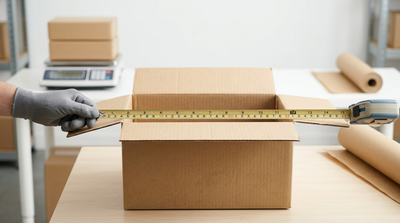
Is Depth the Same as Length? How to Measure Boxes for Shipping

Table of Contents
No, depth is not the same as length. For shipping carriers, Length is strictly defined as the package’s single longest physical side. Depth (which is synonymous with Height in logistics) measures the vertical distance from the box opening to the bottom. While box manufacturers use "depth" to define internal capacity relative to how the box flaps open, commercial shipping carriers ignore the box opening entirely and always treat the longest physical dimension as the length.
Editorial Transparency: TransitMetric is an independent logistics education platform. The measurement protocols and definitions detailed in this guide align with the current 2026 regulations published in the USPS Domestic Mail Manual (DMM) Section 201, the UPS Rate and Service Guide, and the FedEx Service Guide.
DIM & Billable Weight Calculator
Carriers bill whichever is greater: Actual Scale Weight or Dimensional (DIM) Weight. USPS 166 divisor applies to packages over 1 cubic foot (1,728 cu in).
The Core Conflict: Box Manufacturers vs. Shipping Carriers
The root of confusion regarding box dimensions stems from a fundamental misalignment between the companies that manufacture packaging and the commercial carriers that transport it. They measure the exact same physical object using two completely different geometric standards.
The Manufacturer’s Standard (Length x Width x Depth)
Corrugated box producers measure cartons based on the aperture, or the opening of the box. If you look at the Box Maker’s Certificate (BMC)—the round stamp printed on the bottom flap of shipping boxes detailing its physical properties—it will list internal dimensions in a standard L x W x D format.
- Manufacturing Length: The longer side of the box opening.
- Manufacturing Width: The shorter side of the box opening.
- Manufacturing Depth: The inside vertical distance from the opening down to the bottom flap.
Relying on the BMC dimensions printed on the cardboard can lead to costly shipping errors, as the manufacturer's designated "depth" might actually be the longest physical side of the carton.
The Carrier’s Standard (Spatial Orientation)
Shipping couriers—such as FedEx, UPS, and DHL—completely ignore where the box opening is located. To organize millions of parcels inside sorting hubs and cargo planes, carriers rely on external spatial orientation. Their foundational rule dictates that Length is always the longest overall side of the package, regardless of how the box is opened, packed, or laid down on a scale.
Manufacturing vs. Shipping Definitions
Note: Carrier definitions supersede manufacturer specifications when calculating billable volumetric weight or assessing oversize surcharges.
How Shipping Carriers Define Length, Width, and Height
To accurately declare package sizes to logistics providers, you must understand how to measure length, width, and height according to strict courier frameworks.
The Longest Side Rule
UPS, FedEx, and DHL enforce the "longest side" rule without exception. If you ship a tall, narrow box that measures 10 inches by 8 inches at the opening, but stands 20 inches deep, shipping carriers designate the 20-inch side as the Length. The 10-inch and 8-inch sides become the Width and Height, respectively.
USPS Domestic Mail Manual (DMM) Section 201
The United States Postal Service operates under the same spatial logic. DMM Section 201 outlines physical standards for parcels, stating that the length is the longest dimension. Identifying the correct length is critical for USPS shipments, as it determines whether a parcel qualifies as machinable (can be processed by automated conveyor belts) or non-machinable (requires manual sorting and carries a surcharge).
The Mathematical Girth Formula
When measuring packages, carriers use Girth (the measurement around the thickest part of the package perpendicular to its length) to determine if a box exceeds maximum allowable limits. The precise mathematical formula is:
Girth = (2 × Width) + (2 × Height)
Crucially, Width and Height are always defined as the two remaining dimensions after the single longest side (Length) has been mathematically isolated.
The Financial Impact: DIM Weight and Unexpected Surcharges
Misidentifying depth as length rarely changes the raw cubic volume of a box, but entering dimensions in the wrong order into a shipping platform can wreak havoc on your logistics budget through automated penalties.
Understanding Dimensional (DIM) Weight
Carriers charge shippers based on the greater of a package's actual weight or its Dimensional (DIM) Weight—a pricing technique that calculates the theoretical weight of a package based on the physical space it occupies on a truck or aircraft.
The volumetric formula is: DIM Weight = (Length × Width × Height) / DIM Divisor
The DIM Divisors (Current 2026 Standards)
To convert cubic inches into billable pounds, carriers divide the total volume by a specific divisor. Under current 2026 rate tables:
- 139 Divisor: The standard commercial baseline used by FedEx and UPS.
- 166 Divisor: The standard retail baseline used by USPS for domestic priority parcels.
USPS Automated Package Verification (APV)
Modern shipping networks rely on in-line laser scanners at sorting hubs to measure parcels dynamically while they travel on conveyor belts. Under the USPS Automated Package Verification (APV) system, if a merchant inputs "depth" as "length" and creates an orientation mismatch, the laser scanner detects the discrepancy. The APV system automatically recalculates the physical dimensions, identifies the true longest side, recalculates the postage, and pulls the financial discrepancy directly from the merchant’s postage account in real-time.
Warning: Oversize Penalties and Additional Handling Surcharges (AHS)
Misidentifying the longest side of your package can trigger severe financial penalties. For instance, standard FedEx and UPS parcels face an Additional Handling Surcharge (AHS) if the declared length exceeds 48 inches. If a package exceeds a maximum length of 108 inches—or a combined length plus girth of 165 inches—it triggers an "Over Maximum Limits" penalty, which can exceed $1,000 per package in the current 2026 fee schedules.
Worked Example: How Incorrectly Labeling Dimensions Costs Money
To illustrate how conflating depth with length disrupts carrier billing systems, let's follow a hypothetical e-commerce merchant shipping a standard lightweight consumer product, such as a camping backpack, in a corrugated carton.
The Physical Package:
- Actual Physical Measurements: 20" (Longest side) x 14" (Second longest) x 8" (Shortest vertical side)
- Actual Scale Weight: 4 lbs.
The Correct Carrier Orientation:
The merchant correctly identifies the 20-inch side as the Length. Using the standard commercial 139 DIM divisor, they calculate the billable volumetric weight:
(20 × 14 × 8) / 139 = 2,240 / 139 ≈ 16.11 lbs.
Carrier rounding rules dictate that any fraction is rounded up, meaning this 4-pound box is billed at 17 lbs. The carrier API correctly calculates the package's Girth as 2(14) + 2(8) = 44 inches.
The Incorrect Data Entry (Confusing Depth and Length):
The merchant looks at the manufacturer’s BMC stamp, which treats the box opening as the reference point. They mistakenly enter the dimensions into their shipping software as 8" (Length) × 14" (Width) × 20" (Depth/Height). While the base volume (2,240 cubic inches) is identical, look what happens to the carrier's Girth calculation behind the scenes in the software API:
Girth = 2(Width) + 2(Height) = 2(14) + 2(20) = 28 + 40 = 68 inches.
The Operational Penalty:
Because the API now believes the package has an abnormally large girth relative to its "8-inch length," the automated sorting software flags the package as "irregular." When the package reaches the carrier's sorting hub, the optical scanners recognize the physical shape does not match the electronic manifest. Sorting machines automatically divert irregular packages to manual verification lanes. This physical bottleneck bypasses high-speed sorting, frequently resulting in a 12-to-24-hour transit delay, missing the scheduled outbound flight, and generating a retroactive billing adjustment for incorrect dimensions.
Step-by-Step Guide to Measuring Packages for Global Logistics
To ensure automated sorting compatibility and accurate billing, adhere to this universal measurement protocol before purchasing a shipping label.
- Step 1: Lay the Box Flat: Place the fully sealed package on a flat surface in its most stable, natural resting position. Ignore where the top flaps are located.
- Step 2: Locate the Longest Side: Use a tape measure to determine the single longest edge from corner to corner. Record this strictly as your Length (L).
- Step 3: Measure the Second Longest Side: Measure the dimension on the flat surface that runs perpendicular to your length. Record this as your Width (W).
- Step 4: Measure the Remaining Side: Measure the vertical distance from the surface the box is resting on to the top of the package. Record this as your Height or Depth (H).
- Step 5: Round Up to the Nearest Whole Inch: Courier rounding rules require that any fraction over a standard half-inch threshold (and often any fraction at all, depending on the carrier) must be rounded up to the next whole number. A dimension of 14.2 inches must be declared as 15 inches.
Pro-Tip: International Shipments and IATA Resolution 502
When exporting goods via global air cargo or DHL Express, be aware that international networks utilize metric measurements (centimeters) under the Volumetric Ratio standard defined by IATA Resolution 502. Air Waybill (AWB) declarations must reflect precise spatial orientation. Customs clearance delays and heavy cargo terminal holding fees often occur when physical terminal scans contradict the commercial invoice paperwork due to mixed-up length and depth values.
Official Carrier Resources & Standards
For official, primary-source documentation regarding physical parcel definitions, refer directly to the carrier directories below:
- United States Postal Service (USPS): Consult the USPS Domestic Mail Manual (DMM) under Section 201 for physical standards and Automated Package Verification details.
- United Parcel Service (UPS): Refer to the "How to Determine Billable Weight" section in the official UPS Rate and Service Guide.
- Federal Express (FedEx): Review the dimensional weight rules and additional handling criteria in the FedEx Service Guide.
- Fibre Box Association (FBA): For details on manufacturing standards and internal BMC measurements, review the Fibre Box Association Blue Book.
Frequently Asked Questions
Is depth the same as height when measuring a box for shipping?
Yes, for commercial shipping purposes, depth and height are interchangeable terms. Both represent the vertical dimension of the package after the longest side (length) and second-longest side (width) have been identified.
Does the longest side of a package always count as the length?
Yes. Regardless of where the box flaps open or how the manufacturer defines the internal space, all major carriers (USPS, FedEx, UPS, DHL) legally and operationally define the single longest edge as the package's physical length.
Why do box manufacturers and shipping companies measure boxes differently?
Box manufacturers measure internal dimensions (Length x Width x Depth) based on the box opening to help buyers determine if a specific product will fit inside. Shipping carriers measure external dimensions based on the package's overall spatial footprint to accurately calculate cargo load capacity and conveyor belt sorting compatibility.
How do you calculate dimensional weight if you mix up length and height?
While the raw cubic volume (Length × Width × Height) will remain mathematically identical regardless of the order you enter the numbers, entering dimensions in the wrong order causes logistics APIs to calculate the package's "Girth" incorrectly. This artificial girth inflation results in automated sorting errors, delays, or unwarranted oversize handling penalties.
Frankie analyzes carrier rate structures, 3PL fulfillment services, and shipping software to uncover hidden fees and operational efficiencies—helping you build a faster, more profitable e-commerce supply chain.