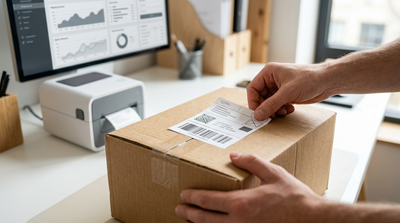
The Shipping Center: Corporate Hubs vs. Independent Retail Outlets

Table of Contents
A shipping center is either a corporate-owned carrier facility (such as a FedEx Office, UPS Customer Center, or USPS Post Office) or an authorized third-party retailer. While corporate locations charge standard carrier retail rates, independent pack-and-ship centers set their own pricing markups, daily carrier cutoff times, and package drop-off policies.
Editorial Transparency: TransitMetric is an independent logistics education platform. The information in this guide references official rules established in the USPS Domestic Mail Manual (DMM), the 2026 UPS Rate and Service Guide, and the 2026 FedEx Service Guide, as well as federal hazardous materials regulations (49 CFR Parts 100-185).
Shipping Surcharge & Rate Worksheet
Manual planning estimate based on user-supplied base rates. Actual carrier invoices vary by shipping zone, residential delivery rules, and weekly fuel tables.
1. Corporate Hubs vs. Independent Retail Outlets: Understanding the Differences
When sending a package, shippers must choose between corporate-owned facilities and third-party retail partners. While they may display familiar carrier logos on their storefronts, their pricing schedules, service agreements, and operational protocols differ significantly. Understanding these distinctions is especially crucial when comparing UPS vs FedEx drop-off networks.
A. Corporate-Owned Carrier Hubs
- United States Postal Service (USPS) Post Offices: Owned and operated by the federal government. They operate strictly under the USPS Domestic Mail Manual (DMM) and charge standard national rates outlined in Notice 123.
- FedEx Office & FedEx Ship Centers: Corporate facilities. FedEx Office locations provide retail packing, copying, and shipping, while FedEx Ship Centers are typically located at sorting hubs and handle heavy-volume commercial drop-offs. Both adhere strictly to the corporate FedEx Service Guide.
- UPS Customer Centers: Corporate facilities located directly at UPS sorting and dispatch hubs. They offer standard retail pricing without franchise markups.
B. Third-Party and Franchise Networks
- The UPS Store: A franchise network. While branded as UPS, these locations are individually owned businesses. They set their own retail pricing margins for postage and packaging supplies, and may charge administrative premiums.
- Authorized Shipping Outlets (ASOs) & FedEx Authorized ShipCenters (FASCs): Independent, multi-carrier pack-and-ship retail stores. They are certified to accept drop-offs and sell shipping services on behalf of the major carriers, but operate as entirely separate business entities.
- USPS Approved Shippers & Contract Postal Units (CPUs): Private retailers authorized to sell postal services. CPUs must charge standard USPS retail rates, whereas independent Approved Shippers are legally permitted to add processing fees.
Advantages of Independent Centers
- Convenience: Often located closer to residential neighborhoods than industrial sorting hubs.
- Multi-Carrier Access: Allows you to drop off USPS, FedEx, and UPS packages in a single visit.
- Packing Services: Comprehensive pack-and-ship labor provided for fragile or complex items.
Trade-Offs & Limitations
- Price Markups: Independent centers typically add a 10% to 40% margin over standard carrier rates.
- Earlier Cutoffs: Carrier pickup sweeps happen earlier in the afternoon compared to central hubs.
- Liability Gaps: Carrier insurance does not activate until the driver picks the package up from the store.
Carrier Service and Network Comparison
| Location Type | Carrier Affiliation | Pricing Structure | Drop-Off Fees | Primary Governance |
|---|---|---|---|---|
| USPS Post Office | Corporate (USPS) | Standard Retail (Notice 123) | None | USPS DMM Section 508 |
| UPS Customer Center | Corporate (UPS) | Standard UPS Retail Rate Guide | None | UPS Rate & Service Guide |
| The UPS Store | Franchise Network | Franchise Retail Rate (Variable Markups) | None (for pre-labeled prepaid packages) | UPS Franchise Agreement |
| FedEx Office | Corporate (FedEx) | Standard FedEx Retail Rates | None | FedEx Service Guide |
| ASO / FASC | Independent Partner | Independent Retail Rates (10% to 40% markup) | Occasional handling fees ($1.00 - $3.00) | Individual business policy |
2. Understanding Retail Pricing: Base Rates, Store Surcharges, and DIM Weight
The cost of shipping a package at a local shipping center is determined by a combination of fixed carrier rules, discretionary retail business markups, and how the physical package occupies space on a truck. (You can forecast standard retail baseline costs using a shipping rates calculator before heading to the counter).
Base Rates vs. Retail Store Surcharges
When you approach an independent retail counter, you are navigating a layered pricing model:
- Base Retail Rates: This is the baseline rate set annually by national carriers (e.g., USPS, FedEx, UPS).
- Retail Markups: Independent shipping centers (ASOs and FASCs) routinely apply a 10% to 40% retail markup over standard carrier retail rates. This is not a hidden fee; it is their necessary operating margin to cover localized commercial real estate, labor, and packaging overhead.
- Package Drop-Off Fees: If you present a pre-labeled, prepaid package (such as an e-commerce return label), corporate centers process it for free. However, independent pack-and-ship stores are legally permitted to charge a nominal administrative handling fee (typically $1.00 to $3.00) to offset labor and storage costs if their specific carrier contract does not fully subsidize the scan.
Dimensional Weight (DIM) in the Retail Space
A common point of confusion at the shipping counter is the difference between actual scale weight and Dimensional Weight (DIM). Dimensional Weight is a pricing technique based on package volume—how much space a box takes up in a delivery vehicle—rather than just its physical heft.
To accurately measure your box for shipping, multiply Length × Width × Height. Retail shipping centers then divide this total volume by a standardized number called a "DIM Divisor." For current 2026 standard domestic retail shipments via USPS, FedEx, and UPS, that divisor is strictly set at 166.
Step-by-Step Dimensional Weight Worked Example:
Imagine a sender brings a large box containing lightweight decorative pillows to an independent shipping center. The merchant assumes shipping will be cheap because the box is light.
- Package Dimensions: 24 inches × 18 inches × 18 inches.
- Actual Scale Weight: 6.0 lbs.
- Calculate Volume: 24 × 18 × 18 = 7,776 cubic inches.
- Apply DIM Formula: 7,776 ÷ 166 (Standard Retail Divisor) = 46.84 lbs.
- Billing Outcome: Carrier rules dictate that fractions are rounded up to the next whole pound. Therefore, the dimensional weight is 47 lbs. Because 47 lbs is drastically greater than the 6 lbs physical weight, the shipping center is required to bill the customer for a 47-pound package.
3. Drop-Offs, Tracking, and Liability: When is a Package Officially "Tendered"?
Dropping off a package at a third-party counter does not immediately transfer legal liability or update national tracking systems. Senders must understand the mechanics of shipping custody transfers, particularly the concept of being "Tendered to Carrier"—the precise legal moment the carrier officially takes custody of your package.
Chain of Custody and Scan Sequence
Note: Dropping a package at an independent retail store does not update public carrier tracking platforms until the driver completes the evening sweep and scans the package into the regional transit network.
The Scan-Based Acceptance Gap
When you drop a package off at an independent shipping center, the retail associate may scan your package into their point-of-sale (POS) system. This is an internal local scan. It does not register as "received" on the carrier's (USPS, UPS, FedEx) public tracking website. A package achieves scan-based acceptance only when it receives a physical scan from the carrier's route driver during their daily sweep, or when it is processed at the regional carrier hub.
The Liability Gap: If a package is lost, stolen, or damaged after you drop it off at a third-party shipping center but before the official carrier pickup scan occurs, standard carrier liability protection (such as standard $100 coverage) will not cover the loss. In this scenario, insurance claims must be processed directly against the independent business's general liability insurance policy.
Declared Value Rules at Retail Counters
When purchasing shipping at the counter, customers can request a Declared Value—stating a monetary value for a package to secure additional coverage in case of loss or damage. At independent locations, ensure that the declared value is actively registered on the carrier’s system rather than just noted as a store-level add-on. Always request a physical paper receipt containing the carrier's official tracking number and a clear itemization of the declared value fee paid.
4. Operational Constraints: Cutoff Times, Hazardous Materials, and Holding Policies
Operating schedules, hazardous material restrictions, and parcel storage capacities vary heavily between corporate hubs and third-party retailers.
The "Daily Sweep" Cutoff Time
Every physical shipping center has a designated pickup time when the carrier's truck retrieves outgoing parcels for transit:
- Late Drop-offs: If a parcel is dropped off after the scheduled cutoff time (e.g., 4:30 PM for FedEx Express at an FASC), the package will sit securely overnight but will not leave the facility until the following business day.
- Weekend Bottlenecks: Packages dropped off after the Friday afternoon cutoff time at an independent retail center generally sit in storage until Monday afternoon. This adds a 72-hour delay before the transit window officially begins.
- Multi-Carrier Network Gaps: When dropping off hybrid commercial economy services (such as UPS SurePost or FedEx Ground Economy, where the private carrier handles the long-haul but hands off to USPS for final-mile delivery), expect an additional 1 to 2 business days of transit time as packages transfer physically between network facilities.
Hazardous Materials (HAZMAT) and Counter Compliance
The shipment of dangerous goods is heavily regulated under the Code of Federal Regulations (49 CFR Parts 100-185). Staff members at independent pack-and-ship stores are rarely certified to accept fully regulated hazardous materials.
Common household items—such as perfumes (flammable liquids), aerosols (pressurized gases), and loose lithium-ion batteries (UN3480 / UN3481)—are frequently rejected at independent counters due to carrier compliance risks and hefty federal fines for improper handling. Customers wishing to ship these items must typically go directly to a corporate carrier hub or a Post Office that features specialized HAZMAT acceptance desks.
Storage and Holding Policies
If you have a package directed to a shipping center for pickup (like a UPS Access Point or FedEx Hold for Pickup site), strict holding windows apply. Corporate and franchise locations will securely store packages for a set duration—typically 5 to 7 business days. If the package is not collected within the designated window, it is flagged as unclaimed and sent "Return to Sender" at the original shipper's expense. Independent centers may also charge a daily storage fee if packages are left beyond their specified store hold limits.
5. Official Carrier Resources & Standards
To ensure regulatory compliance and verify accurate current pricing structures, refer directly to official 2026 carrier manuals and government trade resources:
- United States Postal Service: Check the USPS Domestic Mail Manual (DMM) Section 508 (for recipient services) and Section 604 (for postage payment and approved shipper regulatory guidelines) at www.usps.com.
- United Parcel Service: Refer to the current UPS Rate and Service Guide for retail dimensional weight divisor guidelines (166) and franchise service parameters at www.ups.com.
- FedEx Express & Ground: Consult the FedEx Service Guide for FedEx Authorized ShipCenter (FASC) operational limits (such as the 150 lbs maximum weight limit) and daily sweep cutoff schedules at www.fedex.com.
- Hazardous Materials Transportation: Review the Code of Federal Regulations (49 CFR Parts 100-185) for legal requirements governing dangerous goods and hazardous materials acceptance at retail counters at www.ecfr.gov.
- International Import Thresholds: For international shipping counters, review the official US Customs and Border Protection documentation under 19 U.S.C. § 1321 (Section 321). This establishes the De Minimis threshold—the valuation limit (currently $800) under which international goods can enter the US duty-free. Learn more at www.cbp.gov.
6. Frequently Asked Questions (FAQ)
What is the difference between an official carrier store and an authorized shipping center?
An official carrier store (like FedEx Office or a USPS Post Office) is corporate-owned and governed directly by corporate policies and standard retail rates. An authorized shipping center is an independent, third-party business licensed to resell carrier services. Independent stores set their own service markups, establish their own hours, and may charge drop-off handling fees.
Can I drop off pre-labeled UPS, FedEx, and USPS packages at any local pack-and-ship store?
While most independent pack-and-ship stores accept pre-labeled drop-offs for major carriers, they are not legally obligated to do so. Some stores charge a nominal $1.00 to $3.00 handling fee to accept prepaid drop-offs, while others do not accept certain carriers due to limited storage space or specific network agreements.
Do independent shipping centers charge more for postage than the post office or official carrier sites?
Yes, independent shipping centers often apply a retail markup ranging from 10% to 40% above standard carrier retail rates to cover their operating overhead. To pay the baseline retail rate, you should buy postage directly from official carrier websites or visit a corporate-owned retail facility.
Who is liable if my package is lost after I drop it off at a third-party shipping center but before the carrier scans it?
If a package is lost before the carrier performs their first physical scan, the carrier will reject any liability claim because the item was never officially "tendered." In this case, the third-party shipping center is liable, and you must file a claim directly with the store's management or their business liability insurance.
Frankie analyzes carrier rate structures, 3PL fulfillment services, and shipping software to uncover hidden fees and operational efficiencies—helping you build a faster, more profitable e-commerce supply chain.