What Does Order Fulfillment Mean? Process, Models, and Costs Explained

Table of Contents
Order fulfillment is the complete operational process of receiving, storing, picking, packing, shipping, and managing returns for e-commerce or B2B orders. Managed in-house or outsourced to a third-party logistics (3PL) provider, the fulfillment cycle begins when a customer completes their purchase and ends when the physical delivery is successfully completed.
Editorial Transparency: TransitMetric is an independent logistics education platform. The operational guidelines, dimensional weight standards, and import compliance rules detailed in this article are based on current 2026 frameworks published by U.S. Customs and Border Protection (CBP), the USPS Domestic Mail Manual (DMM), and official service guides from FedEx and UPS.
3PL Pick & Pack Order Estimator
Estimates per-order fulfillment handling only. Excludes monthly pallet/bin storage fees, inbound receiving charges, account management minimums, and outbound postage.
The 5 Core Steps of the E-Commerce Fulfillment Pipeline
The 2026 Fulfillment Timeline
Note: Inbound receiving and outbound transit times fluctuate based on 2026 peak season volume caps, weather disruptions, and local warehouse SLAs.
The fulfillment pipeline is the physical journey a product takes from the manufacturer's inbound freight truck to the customer's doorstep. It relies heavily on automated data systems and optimized manual labor.
Step 1: Receiving and Inventory Ingestion
Fulfillment centers accept inbound freight shipments either as palletized loads or floor-loaded containers (where boxes are stacked loosely to maximize shipping container space). During ingestion, the facility uses a Warehouse Management System (WMS)—a specialized software platform used to track real-time inventory levels and direct daily warehouse workflows. Staff scan barcodes to verify inbound Stock Keeping Units (SKUs) against the original purchase order (PO), immediately updating digital inventory levels on the merchant's storefront.
Step 2: Warehousing and Storage Optimization
Once ingested, inventory is routed to specific warehouse locations such as bins, shelves, or pallet racks. Modern 3PLs optimize this storage based on velocity (how fast an item sells). High-velocity items are staged close to the packing stations to minimize picker travel time, while slow-moving overstock is kept in higher, less accessible pallet racks.
Step 3: The Pick and Pack Process
- Picking: When a digital order drops into the WMS, it generates a pick list. Advanced routing algorithms dictate picking methodologies like batch picking (gathering multiple identical items for different orders simultaneously) or zone picking (workers stay in specific warehouse aisles and pass orders down a line).
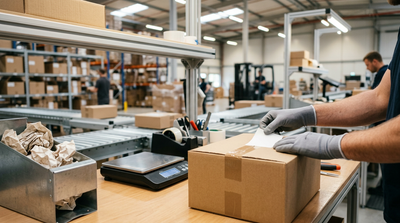
- Packing: Workers select the appropriate packaging to minimize Dimensional Weight (DIM)—a carrier pricing metric that charges based on a box's volume rather than its physical weight. Standard procedure requires using custom dunnage (materials like bubble wrap, kraft paper, or air pillows) to secure cargo and prevent damage in transit.
- Kitting: For merchants selling bundles, warehouses perform kitting—the physical process of pre-assembling multiple SKUs into a single, ready-to-ship unit before an order is even placed, significantly speeding up outbound processing.
Step 4: Shipping and Carrier Handover
Once packed, the WMS utilizes API (Application Programming Interface) connections to automatically generate shipping labels reflecting the correct carrier (USPS, UPS, FedEx, DHL) and service class (e.g., Ground, Next Day Air). Packages are then sorted onto pallets or conveyor belts by carrier to await scheduled daily pickups.
Step 5: Reverse Logistics (Returns Management)
Often overlooked, Reverse Logistics handles the return pipeline. Fulfillment centers receive returned parcels, perform strict visual inspections to assess damage, grade the item's condition, and execute the merchant's predefined protocols—whether that means restocking the item as new, refurbishing it, or routing it to a disposal and liquidation pipeline.
Decoupling the Costs: Fixed Fees vs. Variable Warehousing Expenses
Fulfillment pricing structures can be complex, blending fixed per-action fees with variable volume-based charges. Understanding this breakdown is critical for merchants calculating their true cost per order.
| Cost Category | Billing Type | Operational Mechanics |
|---|---|---|
| Receiving / Inbound Freight | Variable | Billed per pallet, per box, or via a flat hourly labor rate to unload, scan, and shelf-store inbound inventory. |
| Storage Fees | Variable | Calculated monthly based on the physical volume of space occupied (per cubic foot, per pallet, or per bin). Rates typically surge dynamically during the Q4 peak holiday season. |
| Pick & Pack Fees | Fixed (Per Order) | Includes a standard baseline fee covering the first item (e.g., $1.50 to $3.00), plus a small incremental charge (e.g., $0.30) for each additional item in the same order. |
| Packaging & Dunnage | Fixed (Per Box) | Costs for standard white-label boxes, mailers, tape, and dunnage. Custom-branded packaging typically requires additional handling fees. |
| Carrier Outbound Shipping | Variable | Scales based on the carrier delivery zone (distance traveled), shipping weight, and dimensional volume. |
| Accessorial Surcharges | Variable | Penalties and add-ons applied by carriers, including residential delivery fees, fuel surcharges, and address correction penalties. |
Practical Worked Example: Pick, Pack, and DIM Weight Calculation
To understand how warehouse choices impact your final bill, consider a merchant shipping a 4-pound pair of boots. The fulfillment center charges a $2.50 base pick-and-pack fee, plus $1.25 for a standard box and dunnage.
The DIM Weight Impact: The warehouse packs the boots into a 14" x 12" x 10" box.
Formula: (Length × Width × Height) / 139
Math: (14 × 12 × 10) / 139 = 1,680 / 139 = 12.08 lbs.
The Result: The carrier rounds 12.08 up to 13 lbs. Even though the boots only weigh 4 lbs on a scale, the merchant is billed for a 13 lb shipment.
Total Fulfillment Cost Breakdown: $2.50 (Pick/Pack) + $1.25 (Materials) + $18.50 (Carrier Zone 5 rate for 13 lbs DIM) = $22.25 Total Cost.
Logistics Tip: Utilizing optimized box-sizing software inside the WMS to select a smaller 12" x 10" x 6" box would drop the billed DIM weight to 6 lbs, drastically cutting outbound shipping rates.
Fulfillment Models: Self-Fulfillment vs. 3PL vs. Dropshipping
Merchants generally structure their supply chain around one of three primary fulfillment frameworks, each carrying distinct structural and financial trade-offs.
1. In-House / Self-Fulfillment (Merchant-Owned)
The merchant rents their own commercial warehouse space, hires operational staff, and licenses shipping software. This offers maximum control over the unboxing experience and quality assurance. However, it requires massive upfront capital for long-term commercial leases and limits geographic scalability, as all packages ship from a single origin zip code.
2. Third-Party Logistics (3PL) Outsourcing
Inventory is forwarded in bulk to an external, specialized partner who manages the entire physical workflow under contract. This allows merchants to leverage decentralized, multi-node warehouse networks to place inventory closer to end consumers.
Advantages of 3PL Outsourcing
- Unlocks highly discounted enterprise carrier shipping rates.
- Offers decentralized multi-warehouse distribution, enabling 2-day domestic transit nationwide.
- Bound by strict Service Level Agreements (SLAs) guaranteeing daily order processing speeds.
- Converts fixed commercial real estate costs into variable, volume-based expenses.
Trade-Offs & Limitations
- Merchants must relinquish direct, hands-on oversight of their physical inventory.
- Highly vulnerable to hidden variable fees (storage spikes, receiving delays).
- Difficult and expensive to execute highly customized or complex unboxing experiences.
- Requires robust API integrations to prevent inventory sync errors.
3. Dropshipping
The merchant holds zero physical inventory. When an order is placed, it routes directly to a third-party manufacturer or distributor who packs and ships the item directly to the end consumer. While dropshipping requires minimal upfront capital, merchants suffer from razor-thin profit margins, zero quality control, and extended transit times—especially if the distributor ships internationally.
Cross-Border Fulfillment and Regulatory Compliance
For merchants sourcing goods globally or serving international customers, customs compliance dictates the speed and legality of the fulfillment pipeline.
Importing Inventory via Section 321 (19 U.S.C. § 1321)
Under U.S. Customs and Border Protection regulations, Section 321 allows commercial shipments valued at $800 or less to enter the United States duty-free, provided they are imported by one person on one day. Many modern fulfillment networks strategically position warehouses just across the borders in Mexico or Canada. They hold bulk inventory there and fulfill individual direct-to-consumer orders into the U.S., legally bypassing heavy import tariffs under the $800 de minimis threshold.
FDA, USDA, and Dangerous Goods (Hazmat) Storage
Warehouses storing ingestible goods (food, vitamins, cosmetics) or medical devices must maintain active FDA registrations. This legally mandates strict facility requirements, including climate control, sanitization protocols, and rigorous lot-tracking to manage product expiration dates and potential recalls.
Hazmat Fulfillment Restrictions: Products classified as Dangerous Goods—such as lithium-ion batteries, perfumes, and aerosol sprays—severely restrict fulfillment options. These items often require specialized storage bunkers and are legally restricted from entering commercial passenger air transit networks, limiting them to slower Ground shipping services.
International Shipments (DDP vs. DDU/DAP)
When fulfillment centers ship orders to international buyers, the customs billing structure falls into two categories:
- DDP (Delivered Duty Paid): The seller collects all estimated customs duties and taxes at checkout and assumes responsibility for paying them. The package clears customs smoothly and is delivered straight to the buyer.
- DDU (Delivered Duty Unpaid) / DAP (Delivered at Place): The seller pays only for the freight. Upon reaching the destination country, customs holds the package until the end consumer pays the outstanding duties and taxes. Modern e-commerce brands heavily favor DDP fulfillment to eliminate unexpected fees and poor customer experiences at delivery.
Strategic Bottlenecks: Cutoff Times, Peak Seasons, and Carrier Holds
The fulfillment process does not operate in a vacuum. It is heavily influenced by the capacity constraints of national carrier networks.
Daily Fulfillment Cutoff Times
Every warehouse enforces a strict internal "same-day shipping" cutoff—typically between 12:00 PM and 2:00 PM local time. This cutoff is not arbitrary; it is dictated by the facility's daily carrier pickup schedule. Orders that drop into the WMS after the cutoff time are automatically slotted into the next business day's shipping queue.
Inbound Blackout Periods (Peak Season Prep)
During the Q4 holiday peak season (October through December), 3PL warehouses face severe labor constraints. Facilities often limit or implement "blackout periods" on inbound inventory receiving. Checking in new pallets, which normally takes 48 hours, can stretch to 5–10 business days during Q4. Merchants who fail to forward inventory by September frequently face prolonged stockouts.
Weather Disruptions and Carrier Caps
Major carriers (UPS, FedEx, USPS) actively manage their grid capacity. During massive promotional events like Black Friday and Cyber Monday, carriers impose strict daily shipping volume caps on individual fulfillment facilities. Even if a 3PL packs 10,000 orders in a day, if their UPS volume cap is 5,000, half of the packed orders will sit on the dock for an extra 24 to 48 hours awaiting outbound transit.
Frequently Asked Questions
What is the difference between shipping and fulfillment?
Shipping refers solely to the physical transport of a parcel from point A to point B by a commercial carrier (like USPS or FedEx). Fulfillment represents the entire overarching operational loop. It begins with the digital order placement and includes inventory receiving, warehousing, picking, packing, generating the shipping label, carrier handover, and managing reverse logistics (returns).
How does a 3PL fulfillment company integrate with my store?
Modern Warehouse Management Systems (WMS) utilize automated API (Application Programming Interface) or EDI connections to sync directly with platforms like Shopify, WooCommerce, or Amazon. This integration instantly downloads new orders into the warehouse queue and pushes real-time carrier tracking numbers back to the merchant's storefront once the shipping label is generated.
What is a fulfillment Service Level Agreement (SLA)?
A fulfillment SLA is the contractual agreement binding the warehouse to specific operational metrics. Common SLAs include speed guarantees (e.g., "99.8% of orders packed within 24 hours of data receipt") and accuracy guarantees (e.g., "99.9% order pick accuracy"). If the 3PL fails to meet these metrics, they typically owe the merchant financial credits.
How do dimensional weight (DIM) rules impact my packaging choices?
Carriers use the DIM formula, typically (Length × Width × Height) / 139 for domestic shipments, to estimate a package's spatial volume. If the DIM weight is higher than the actual weight on the scale, the carrier bills for the higher number. Shipping small, heavy items in unnecessarily large boxes spikes fulfillment costs, which is why optimized packing software is critical to minimizing box footprints.
Official Carrier Resources & Regulatory Standards
For current 2026 procedural data, integration documentation, and regulatory compliance standards regarding fulfillment and supply chain logistics, consult the following official primary sources:
- FedEx Fulfillment and Storage Standards: Refer to the official FedEx Service Guide for physical prep guidelines, standard packaging requirements, and API-WMS system configurations. Access via the FedEx Official Site.
- UPS Supply Chain Solutions Standards: Consult the UPS Service Guide and UPS Supply Chain Solutions Terms & Conditions for commercial storage compliance, hazardous materials handling, and outbound zone charts. Access via the UPS Official Site.
- USPS Physical Standards for Outbound Shipments: See the USPS Domestic Mail Manual (DMM), specifically Section 602 (Addressing Standards) and Section 101 (Physical Standards for Letters and Parcels) for mailpiece preparation. Access via USPS Postal Explorer.
- U.S. Customs and Border Protection (CBP) Import Rules: Review the official legal guidelines on Section 321 (19 U.S.C. § 1321) regarding duty-free entry limits on international e-commerce bulk imports. Access via the CBP Official Site.
Frankie analyzes carrier rate structures, 3PL fulfillment services, and shipping software to uncover hidden fees and operational efficiencies—helping you build a faster, more profitable e-commerce supply chain.